Ballplayers and some major media folks laugh at the guys behind the Excel spreadsheets, calling them (us?) things like "geeks", "stat-heads", "nerds". Some of that may be true though I think most of them (us?) view things differently; guys/girls making better use of data to make better decisions and arrive at conclusions. Maybe that's just me, though.
And now, we have the Uber-geek of all time, at least in inside baseball circles. Presenting Nationals' GM Jim Bowden on a Nats-customized, tricked out Segway. Yeehaw!
You go, Jimbo. Maybe he can use that to escort Elijah Dukes to his parole officer.
Monday, February 25, 2008
Jim Bowden declared Uber-Geek of the world!


Another reason to cheer for Jeter
 Yes, I am a Yankee fan even though I don't worship at Jeter's altar. Love the guy. My kids love the guy. I just don't worship him blindly, as you saw last week. But give the guy his due when deserved.
While he is notoriously bland with his comments, he still manages to say the right things, act the right way, defer appropriately, deflect like Teflon. His comments this weekend (sorry for the Monday posting) are right on with what we need more of: Support for blood testing in MLB.
"You can test for whatever you want to test for," New York Yankees captain Derek Jeter told Bloomberg News. "We get pricked by needles anyway in spring training, so we have a lot of blood work to begin with."
I've been on the record about blood testing and I think it's imperative that the leaders of all sports come around to taking whatever measures needed to ensure integrity remains. Let's hope the Union leaders don't stonewall again, even if that's their right and "obligation". Let it be collectively bargained if need be, but it needs to happen. Now.
-=-=-=-=-=-=-=-=-=-=-=-=
UPDATE: Looks like there's more, and honestly, when ISN'T there more about this stuff? Not only Jeter here and it's worth a read. Some good quotes below:
Asked about the issue Sunday, Jeter clarified his position to the Daily News.
"(The problem) has gotten so much attention now, I think it would probably silence a lot of people that were critical of guys ... so I wouldn't mind it," Jeter said. "I can only comment on myself; I don't know about other people. I don't like needles very much, but I wouldn't mind it."
"I'm not saying I would ever be in favor of it, but if we did do it, that would be the only way the general public would finally believe that baseball is completely clean," said Mike Mussina, the Yankees' players union representative. "But I don't know if it will ever come to that."
Jason Giambi, who was at the center of the BALCO scandal, said: "I'm up for whatever they want to do. I don't really care."
"This has to be a union decision, not an individual one," he added.
Nice, Giambi. "I really don't care." Good work on that one.
Then Moose, who definitely seems to be much more outgoing and media friendly this year, added this little throwaway line, which is a joke if you ask me. Comparing what professional ballplayers have to be subjected to (in terms of testing) to traditional corporate jobs is a joke. Doing so makes one look foolish.
"Nobody else, in any facet of business, drug-tests with a blood test - not in the corporate world or anywhere else," Mussina said. "If they ever find an HGH test that's a urine test, great. But until we can test for everything, we're going to be questioned."
I can't wait until the games begin and this slowly fades into the ether.
A bummer of a story
 It's one thing to discuss the bummers in sports when they are self-inflicted (like steroids), but it's another when they are family bummers. Here is the story about Don Mattingly and the sad demise of his marraige. OK, divorce is a bummer, period, but that Donnie had to abandon his managerial dreams when he was on the doorstep of achieving them is really painful. That his marital woes may have been at least a part of the reason for his retirement after the 1995 playoffs stings that much more.
Here's hoping Donnie and his wife can work this out, and soon.In 1995, just a month after he hit .417 in his first - and only - postseason series, Mattingly quit the game. The same year, his wife was arrested in Indiana for driving a car while intoxicated, court records show. Though he publicly blamed his bad back for his retirement, Mattingly's friends said his decision was partially fueled by his wife's drinking.
-----
"This is not the first time we've all had to go through this."
Friday, February 22, 2008
Foiled by an 11 year old?
 Looks like Roger Clemens' claims that he never attended Canseco's pool party back in 1998 might be foiled by a then-11 year old's picture.
The photo is owned by a young man who attended the party when he was 11 years old and took photos of his baseball heroes, including Clemens. Richard Emery, one of the lawyers for Clemens accuser Brian McNamee, was aware that such evidence had been circulating this week.
"We have reason to believe it's reliable evidence," Emery told the Daily News on Thursday. "We believe there's photographic evidence that shows Clemens was at a party he says he wasn't at."
More good times for Clemens ahead.
Thursday, February 21, 2008
Did I say MVP? I meant just really good
 ARod just came out and claimed that Jeter would have an MVP season.
“I think Jeter is going to have an MVP season. That’s my prediction for the year,” Rodriguez saidOf course, this only means that the Yanks'
Remembering 1.12
 An article by Jonah Keri on ESPN.com reminded me just what an incredible year 1968 was. 1968 is remembered as "The Year of the Pitcher" and without a doubt, Bob Gibson was the pitcher of the year.
Rather than rehash everything Keri wrote, below are a few of the most mindnumbing stats for Gibson that year:
- His 1.12 ERA was the lowest figure in a season not played in the Deadball era
- Gibson completed 28 of his 34 starts, 13 of them for shutouts
- 268 strikeouts
- From June 2 through July 30, Gibson threw 99 innings -- and gave up two runs. According to baseball researcher Bill Deane, the two runs Gibson allowed were the result of bad luck more than anything. One came on a catchable wild pitch, the other on a bloop double that landed inches fair. Earlier that season, Don Drysdale set the record for most consecutive scoreless innings with 58 2/3. Orel Hershiser would break that record 20 years later with 59. Yet Gibson's streak is regarded by many as the most dominant stretch of pitching in major league history.
- Denny McLain, who won 31 games in 1968, faced Gibson in Game 1 of the World Series that year and McLain's 1.96 ERA ranked fourth in the AL, behind Dave McNally (1.95), Sudden Sam McDowell (1.81), and Luis Tiant (1.60)
- His 17 strikeouts in Game 1 of the 1968 World Series set a World Series record that still stands.
Take a look at his game log to the right. Note that he went PAST 9 innings 5 times. Can you imagine the fall-out if today's pitchers were used the same way? Joba Rules? Ha!!!
And the aftermath of 1968:
- After the 1968 season in which major leaguers batted .237 and in which 21 percent of all games were shutouts, the height of the mound was reduced to 10 inches.
- From 1903 through 1968, this height limit was set at 15 inches, but was often slightly higher, sometimes as high as 20 inches (50.8 cm), especially for teams that emphasized pitching, such as the Los Angeles Dodgers, who were reputed to have the highest mound in the majors
Rock, Paper, Scissors
 Jeter and Stick Michael (the Yanks long-time scout) have come out in response to the outcry about Jeter's declining range and defensive skills. Good for them. Here's their defense, in two parts, Jeter first:
"Maybe it was a computer glitch," the three-time Gold Glove winner said of the report. But Jeter just didn't laugh this one off. He defended himself, saying, "Every [shortstop] doesn't stay in the same spot, everyone doesn't have the same pitching. Everyone doesn't have the same hitters running, it's impossible to do that."Jeter, 33, pointed out you can get the exact same ground ball off the exact same pitcher and there could be an average runner or there could be Ichiro running. "How can you compute that?" he asked
And Stick had this to say, with my emphasis, as usual:
"You simply can't do that by those charts, that's a bunch of baloney," Michael added. "It's disgraceful. You have to use a scout's eye to determine range."
What about Jeter's range now in his 13th major league season?
"It's not as good as it was, but it's not bad," Michael said. "You might put some people ahead of him range-wise, but that doesn't mean they are better shortstops. Look how sure-handed he is, look how clutch he is. That makes up for a lot."
So, Stick says you need a scout's eye to REALLY determine a player's range as the statistical analyses don't adequately capture pitching types and Jeter adds in the men-on-base dynamic. Since I don't know how Zone Rating or the other defensive stats are computed, let's table that for another time. But what's so funny is that he uses "clutchness" as a defense about Jeter's defense. (rolls eyes) And he also readily admits Jeter's range isn't as good as it was. I'm not as young as I was, either.
So good defense beats clutch but clutch beats bad defense? Newfangled rock/paper/scissors?
Shysterball had a fun look at this, too, by the way.
ARod becoming Seinfeld character
 Like the "close talker" (see picture to right) or "Crazy" Joe Davola, or Bubble Boy, the braless wonder from Seinfeld lore, Alex Rodriguez is quickly becoming his own Seinfeld-esque character. I christen thee, The Inappropriate Comment Guy (or ICG from here on out; my blog, deal with it).
"What now?", you ask. Well, it appears that ICG tried to make a funny or lighthearted reference to steroid testing, claiming he got tested 9-10 times last year. Whoops! Being tested that many times would seem to indicate that he was under suspicion of something, possibly amphetamines.
"Last year, I got tested 9 to 10 times," he said. "We have a very, very strict policy, and I think the game is making tremendous strides."
The number of tests he cited is substantially higher than those mandated by baseball's collective-bargaining agreement.
Of course, Yanks management has helped to try to extricate ICG from his latest hole with helping him with this "official statement" (which I can't stand):
On Wednesday night, Jason Zillo, the Yankees' media relations director, issued a statement on behalf of Rodriguez to further clarify his original comment.
"My quote from earlier today was taken literally," the statement said. "I was not tested 9 or 10 times last year. I was just using exaggeration to make a point. My intent was simply to shed light on the fact that the current program being implemented is working, and a reason for that is through frequent testing. I apologize for any confusion I may have caused."
ICG, why do you so often stumble on things that are so easy to step over or around? Just avoid the traps and you'll be OK. We, the fans, really want to embrace you, but you make it tough sometimes with these proclamations. We "get it" that you're not Jeter. Few are that media savvy (or vanilla). But for a guy who is protrayed as intelligent, you sure do step on your own tongue too often.
Quick personal story: He reminds me of a buddy of mine who often makes an inappropriately timed joke or comment. A few years back, we're away at a Boys Weekend (an annual thing for us) and we've already had a few beverages and reading for a vicious battle of quarters before going out for the evening's activities. Right as we're about to begin, the music's blaring, everybody's excited, amped up and he says "Wait a second. I have to make a quick announcement!" So we figure it's something benign or maybe even funny. "My parents are getting divorced" was his proclamation. A six-man buzz kill. Inappropriate comment guy to the rescue.
ARod's becoming that guy who's unable to discern when he should table his thoughts or tone down his "act".
Wednesday, February 20, 2008
Is Jesse Barfield right?
Jesse Barfield, former MLBer, is covering the Blue Jays these days. Thanks to the miracle of the Internet, I learned today that he penned an article on the CBCnews website entitled "Trust, loyalty among teammates a thing of the past". Seems that he attributes the public nature to this PED mess to free agency and the lack of loyalty and familarity in today's lockerrooms. He hints that any PED usage would have been dealt with internally and not discussed outside the lockerroom of his era.
I half-agree with him: PED use was not discussed outside the lockerroom during his era. But why? Because we, the blissfully ignorant public, were blissfully unaware of the increasing numbers of players turning to the syringe for an edge. The lack of focus on this issue kept the proliferation of PEDs to the shady backgrounds of lockerrooms and gyms. The media coverage and scrutiny (thank you, Internet!) that's part of today's era shines a light on those shady areas that we previously left unexplored.
Turn the dial in the way-back machine to the 1950s and '60's and we find the Mantle/Ford/Martin extracurricular "exploits" charming, not scandalous. The writers protected the stars they covered; today the writers (and there are a ton more, all with camera phones) look for any story they can run with. Can't blame the writers; they are doing their jobs (sell papers/advertising).
Back to Barfield. He played from 1981-1992, right in the early stages of the steroid era. Here is where I disagree with his claim that things would have been dealt with internally, self-policing if you will. If self-policing were so effective, we would not be in the PED mess we're in now. (Is that too pollyanna-ish? Perhaps.) Were there too few stand-up guys, leaders, men of conviction and character? Or was the allure of free agent contracts that made guys abandon their beliefs in search of generational wealth? Regardless of the reason, the internal "kangaroo courts" failed to stem the steroid tide.
One thing you could always count on was what happened in the clubhouse, stayed in the clubhouse. But thanks to players who would rather make a name for themselves off the field rather than on the field, that is no longer the case.
So he seems to be condoning PED usage, until you get to the next paragraph:
Now, don't think I condone the use of steroids, HGH, or any other drugs, but it was a code that we lived by from day one. And now teammates are selling each other out, and throwing each other under the bus. That is so sad to me.
That is PRECISELY how the steroids infiltrated MLB. No one stood up, said something, screamed from the mountain tops, talked to the press, confided in MLB Union leadership, forced Union leaders to enact change. It's long overdue to end the ostrich-head-in-the-sand routine. We, the fans, are demanding a level of transparency previously unseen in professional sports. It's time to get it all out in the open. Blood testing (even if stored for future testing when better methods are available) should be a given. The money is there. The time is now.
Tuesday, February 19, 2008
Adminstrative update: remote blogging
 Due to an update in the web policy at work, it appears that all blogging, not just posting but also commenting to any blog, is now being blocked. Could be temporary, could be permanent. As of 2pm or so today, I noticed the change when trying to edit the last posting, unfortunately.
The good news is that I can post here via email. So, if you notice strange footers, you'll know I emailed it from my yahoo.com account.
Thanks again for your viewership.
--Jason
Great moments in screwing Kansas City
 The Yanks have made a science out of screwing the Kansas City baseball clubs out of their stud players forever. Baseball-Reference.com's TIBH section is always a great place to find interesting tidbits. Today's entry has one more of the KC-NYY trades that forever helped the Yanks and screwed over the Royals/Athletics.
1957 - The Kansas City Athletics ship pitchers Art Ditmar, Bobby Shantz, and Jack McMahan, and infielders Clete Boyer, Curt Roberts and Wayne Belardi to the Yankees. In return they receive pitchers Mickey McDermott, Tom Morgan, Rip Coleman and Jack Urban, OF Irv Noren, plus infielders Billy Hunter and Milt Graff. Roberts didn't go to New York City till May 4, while Boyer went a month later. Hunter and Urban don't switch until April 5. The veteran Shantz and Boyer will be valuable pickups for New York, with Shantz leading the American League in ERA this year, and Boyer a tough defensive 3B for eight years in pinstripes. The A's will eventually admit that when they signed Boyer for a $40,000 bonus in 1955, it was on behalf of the Yankees, with the understanding that they'd later ship him to NY.
A now-dated Baseball Almanac essay took a look at the KC-NYY underground "shuttle" with a particular focus on the 1955-60 seasons, though it was in effect for a good part of the 1950's and 60's. From the accompanying essay:
Of course, the Yankees were the richest and most resourceful club in baseball, then as now, and they found a way to ensure a continuous supply of good players. They managed to turn one of their American League rivals, the Kansas City Athletics, into a virtual farm team.
How did this happen? Connie Mack's family sold the Philadelphia Athletics in 1954, and Yankee principal owner Dan Topping arranged for one of his business friends, Arnold Johnson, to buy the A's and move the team to Kansas City. It's still unclear how much influence the Yankee ownership held over the A's, but the two teams then embarked on a six-year series of trades. These trades, as we shall see, almost always favored the Yankees.
The Yankees, in fact, rarely traded players with any other team in this six-year period. From 1955 to 1960, the Yankees gained many outstanding players from Kansas City, and managed to give only marginal value in return. It must have worked, since the Yankees won four more pennants in a row beginning in 1955, while the new Kansas City team struggled to stay out of last place.
Were the A's simply bad traders, or did the Yankees and Athletics have some kind of secret agreement that gave the Yankees their choice of all of Kansas City's good
players?
BONUS MATERIAL: For more reading material on this strange dynamic period, I'll point you to a few pages from The Kansas City Athletics: A Baseball History, 1954-1967 By John E. Peterson. Take a read from page 138-139.
EXTRA CREDIT READING: If you're so inclined, go grab a copy of The Kansas City A's and the Wrong Half of the Yankees: How the Yankees Controlled Two of the Eight American League Franchises During the 1950s (the picture above is the cover from the book). No doubt it's an interesting read!
Pettitte's "truthiness" provides roadmap for others
 No matter your thoughts on Pettitte and his "truthiness" that was on exhibit yesterday, he certainly provided the roadmap for others accused or found guilty of PED use to recapture something. Not their reputation, but maybe a modicum of respect.
The previous-outted users gave us the following:
- McGwire: refusal to acknowledge followed by a life in seclusion.
- Bonds: reliance on the "unknowingly" clause. Plus refusal to admit in public what he admitted under oath, followed by continued arrogance, exacerbated by a nagging perjury charge for lying under oath.
- Giambi/LoDuca: sorry about doing something, but won't mention "it" by name for fear of voiding big money contract.
- Clemens: steadfast denials, aggressive press conferences, hand-selected interviewer for TV interview, ending up on Capital Hill, getting ripped by our Nation's fine representatives, possibly ending up in a Bonds-esque perjury hangup.
- Palmiero: Wag finger in Congress' face, then get busted a few weeks later. Fade to black
- Others: Silence
- Others: Unknowingly, ignorance
- Others: Mislabeling of products
- Others: No hablo Ingles
- Canseco: Embracing of the truth and shouting it from the mountaintops. Publish book(s)
- Caminiti: Admit it and discuss it, but not actively assist MLB in identifying or fixing the problem. Sadly, for Caminiti, the result was an untimely death.
So what did Pettitte do yesterday that others will surely try to replicate: contrition, humility, a sense of human-ness. Pettitte's likeability and God-fearing persona will and has helped him. Sen. Waxman nearly knighted him last week. The press has been praising Pettitte's press conference and his apparent honesty. But, that doesn't diminish the fact that he did cheat to gain an advantage. Maybe not to throw harder but to get back on the field faster.
Is that more noble? I guess so. I want my players to bust their tails to get back on the field/court/ice as fast as possible and I understand those players seeing a possible remedy to help them get better faster. But, I have to view these transgressions thru the eyes of a father of two young boys, the oldest of which is quickly becoming a very smart baseball fan: How would I explain this Player's actions to them? Was it the right thing to do? Why or why not? My son has already been peppering me with questions about "why is Clemens and Pettitte on TV?" but not in uniform? He knows about steroids. He wants to know if his favorite players used them or not. He's not yet 8 years old.
Jayson Stark has a good review of Pettitte's performance yesterday. He discusses how Pettitte's truthiness provides that roadmap (sorry for the big quote-grab, but it's well done):
Actually act like a real person. And talk like a real person. And paint a picture, for the world to see, of how an otherwise level-headed human being somehow got sucked into the depths of baseball's magic-syringe culture.
So when Pettitte spoke into those microphones Monday and said he'd taken these drugs out of "stupidity" and "desperation," he seemed as believable as any baseball drug culprit ever has.
When he talked about how he made the torturous decision to tell congressional investigators about how his father injected him in 2004 because "If I didn't bring it up, I couldn't sleep at night," he sounded as genuine as any of these guys has ever sounded.
A phony doesn't say: "Part of me was a nervous wreck and scared to death to come up here today."
A phony doesn't tell you stories about his wife's referring him to a Bible passage on the plane ride to Washington, a passage that reinforced the lesson that "I needed to tell the truth under oath."
A phony doesn't say: "If people think I'm lying, they should call me a cheater."
I listened to this guy speak for an hour, and he never sounded like a guy who was trying to stay "on message" or was trying to stay on some holier-than-thou script. He sounded like a man who made a b-i-i-i-i-g mistake. And knows he has to live with the consequences. And thought there was value in trying to explain to all of us how something like that can happen, even to the last guy in the whole sport you ever thought would "cheat."
________
In related blogging circles, Shyster also had something to add about the deification of Pettitte.
=-=-=-=-=-=-=-=-=-=-=-
Well, maybe not after all. During the writing of this post, I learned that Tejada, under the advice of his attorneys, will not comment on his inclusion in the Mitchell Report.
The FBI has launched an inquiry and Tejada could face jail time if found guilty.
"I can't really talk about that. It's not my position to talk about that," Tejada said. "Right now, my mind is really focused on just playing baseball."
Sponsor a stadium for just under $250K per game
Looks like the Yanks are flexing their might again, this time doing so to help pay the bills. Seems that to be the Yanks top sponsor will cost some conglomerate upwards of $20 million per year. I can see the sales pitch:
Yanks Ad Sales rep: "Mr. CEO, you can virtually pay all of ARod's deal yourself, and in return, we'll plaster your logo all over the park and guarantee you a sweet new luxe box in the new Stadium. Parking included. Cost is averaging a smidge under $250,000 per home game, less if they make the playoffs!"
Mr. CEO, after hesitating to ponder the impact his shareholders might have to bear: "Sign me up!"
Good to be the 800 lb. gorilla sometimes.
Sunday, February 17, 2008
Jeter's Inconvenient Truth
Garret Atkins, the third baseman for the Rockies, recorded 41 fewer outs than was expected of him. But does that mean that Atkins is a bad fielder? The stats would say yes. But perhaps his coach is telling him to play near the line, putting him out of position of balls that are running through zones that third basemen are expected to cover and being gobbled up by Tulowitzki, who is being told to play a shade deeper to help cover Atkins' ground. Such a strategy would artificially drop Atkins' outs recorded while simultaneously increasing Tulowitzki's, but, looking at the stats alone makes it difficult to say if this is the case.  Even lifelong Yankee fans (like me) have to admit that Jeter's defense, while sometimes "glamorous" (see: the jump-throws, "the Flip", "the Dive", etc.), is overrated. His range has been lacking for years and getting worse. Maybe we don't see it because we don't want to, but it's real.
We knew ARod was a superior SS when we got him in 2004, but we allowed and accepted ARod's deferral to 3B since "Cap'n Jetes", as you Neyer-ophiles will recognize him as, was the face of the team. How dare someone, anyone, infringe on Jeter's "territory"? Blasphemous.
With ARod at 3b, plus Garciaparra fading and injured, Tejada never really a gold glover either, and some-lesser know SS not gaining the cred fast enough, Jeter won 3 Gold Gloves, furthering the beliefs that he was a better SS than the numbers told us.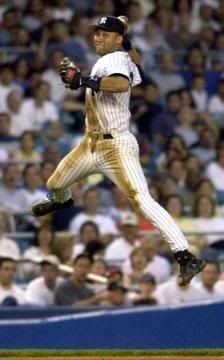
We've seen the discussions about Zone Rating, in fact, here's a 2006 review of the SS Zone Ratings. Jeter rarely fares well using these new-fangled statistical reviews. Tough to see it, but at what point do the Yanks have to face this and start considering a position shift? ARod's probably too big now and I am not sure Cano is a SS either. The politics behind moving Jeter are fierce. But, Mantle shifted to first base late his career, why not Jeter?
With a cap tip to Ballbug, we have yet another review of Jeter and SS's: What's interesting about this article is one of their conclusions after discussing how good Troy Tulowitzki is and how seemingly below average his 3B partner (Atkins) is. It's easy to bash Jeter but they give Atkins the pass this way: Derek Jeter, the New York Yankees shortstop who is often hailed for his defensive prowess and has won three Gold Gloves, ranks dead last in the majors, coughing up 13.81 runs per season. Before the 2004 season, the Yankees traded for A-Rod and shifted him to third base in deferrence of Jeter, but based on these numbers, that move could be costing them 23 runs per season. Would the Yankees be better off with A-Rod at SS? Probably, but I'm a Red Sox fan, so I'll keep quiet on this one.
 An inconvenient truth? At what point do the Yanks have to seriously consider replacing Jeter at SS and moving him to 2B or 1B? You tell me. If the answer is now or next year, then with whom? Making things tough is that Jeter is the Captain, the face of the organization, of success, of what's good about the game. We need to stop trying to hold onto the nostalgia when it's detrimental to the team's forward-looking success plans and make the moves that will prolong success. And that means developing a plan to reposition Jeter, with his support and blessing.
It's time to start.
UPDATE: The guys at Pride of the Yankees followed up with some more Jeterriffic fielding data and discussion. Worth a gander.
Friday, February 15, 2008
The time has come: Store blood tests
 In the days since the Clemens/McNamee trainwreck, I was thinking how we can avoid this as we spin forward. How are the players of today and tomorrow going to prove they are playing clean? Gammons discussed this today, sort of. Buster Olney once proposed the storing of blood samples until a reasonable test is developed. The MLBPA has repeatedly shot this idea to smithereens.
I was checking up on some other stuff and I remembered that idea. Why aren't we taking samples NOW for when there's an appropriate test? Would there be a greater deterrent? Some quick checking around and I found this from a month ago (during the Selig/Fehr/Mitchell hearings), which I thought was interesting:
[World Anti-Doping Agency's new president John] Fahey challenged baseball's policy on human growth hormone. Baseball has pledged to adopt any validated urine test but does not test blood. Baseball said there is no commercially available validated test for HGH.
"Equally reprehensible is their blatant disregard for the truth," Fahey said. "Contrary to what they have told Congress this week, there is a reliable test for HGH; the storing of blood is practical, in fact has been effectively in practice for some time in World Anti-Doping Code-compliant testing."
The WADA statement said commercial kits for HGH blood testing are in development and that it offered to host a meeting between MLB and WADA experts. WADA also said baseball should store blood and serum, which might contain HGH that is more stable, for future testing.
[Rob Manfred, MLB's executive vice president for labor relations] pointed out that Fahey said an HGH blood test for commercial use is only in the process of being created.
Now, I know these two sides (the Union and WADA) don't trust each other any more than Clemens and McNamee, but what's the harm in collecting samples until there's a test? If for no other reason than as a deterrent. Tell ya what, if I was a player on HGH and they started storing blood/serum, I'd stop instantly.
I don't want to hear the cost of testing since MLB is now a $6B business. The cost can be borne by every team. Thirty teams x 25 players x one test per month x $50 test (estimate) = $450,000. And of that estimate is off by a lot (say it's $200/test, 4x higher), the cost is still less than $2M. Seems like an awfully small amount to pay for integrity, no? Considering that MLB paid approx. $20M (10x my higher cost estimate!) to Mitchell for his report, that seems darn reasonable. Now, that estimate is for only players on MLB clubs and therefore inherently understated, but so what? Again, if we say it will cost $5M/year to test all MLB players once a month, all year, that STILL seems reasonable. In other words, at $5M/year to test everyone for HGH, each team pays less than $170K. Really, what's the hold up? The Union? Probably, but it's time to change directions, for the good of the game.
It's an idea who's time has come. Integrity has a cost and a value. Baseball has lost a good degree of it's integrity over the last 20 years. It's time to get it back.
And now, the focus shifts
I'm doing my best to turn my sights from Congressional hearings, depositions and affidavits to the greatly anticipated (and quite frankly, needed) Spring Training. We're seeing lots of previews and such but I wanted to point out Jayson Stark's latest, which is worth a read. What Jayson does well is polling insider baseball men to get their views. It's a good way to gauge what the insiders are looking at or concerned about.
In addition to "Most intriguing spring stories" for each league, here are some of the results of his unscientific polling:
Most improved teams (NL)
- Mets
- Diamondbacks
- Cubs
Most improved teams (AL)
- Tigers
- Mariners
- Rays
Most unimproved teams (NL)
- Pirates
- Marlins
- Giants
Most unimproved teams (AL)
- Athletics
- Orioles
- Twins
Worst free-agent signings
- Carlos Silva, Mariners (4 years, $48 million)
- Scott Linebrink, White Sox (4 years, $19 million)
- Aaron Rowand, Giants (5 years, $60 million)
I'll add this whole section since I LOVE this sorta thing:
Best trades
- Mets get Santana for a sprint champ who might never hit (Carlos Gomez) and three pitching prospects who might never win as many games combined as the 93 Santana won for the Twins all by himself.
- Tigers get a 24-year-old four-time All-Star (Cabrera) and a 26-year-old two-time All-Star (Willis) from the Marlins for two tremendous prospects (Cameron Maybin and Andrew Miller), plus four deal filler-outers who include one minor leaguer (pitcher Burke Badenhop) who's actually older than Cabrera.
- Orioles get three excellent young arms (Troy Patton, Matt Albers and Dennis Sarfate), plus the useful Luke Scott and a third-base prospect with power potential (Mike Costanzo), from Houston for a player (Tejada) who got scorched by the Mitchell report about 20 minutes after the press conference. "If they'd just waited two days," one of our panelists said of the Astros, "wouldn't the price tag have gone down dramatically?"
- Poll tidbit: Here's a no-doubt-about-it sign that the most evenly matched monster trade of the winter was the six-for-two extravaganza that sent Haren from Oakland to Arizona. Three of our balloters gave the Diamondbacks "best trade of the winter" votes. Two thought the A's made one of the best trades of the offseason. And four more said both teams made out great.
Three most outrageous contracts (free agent or otherwise) [EDIT: only first one shown]
- Yankees toss $275 million over 10 years, plus a chance to make another $30 million, at Alex Rodriguez, even though (A) no other team appeared to be within $80 million of that, (B) he turns 33 in July and (C) he couldn't possibly have been more desperate to go back there. Worked out just fine for "60 Minutes," anyhow.
Rookies to watch (NL)
- Jay Bruce (Reds CF)
- Colby Rasmus (Cardinals CF)
- Cameron Maybin (Marlins CF)
Rookies to watch (AL)
- Evan Longoria (Rays 3B)
- Adam Jones (Orioles CF)
- Clay Buchholz-Jacoby Ellsbury (Red Sox tag team)
Not quite sure why Joba was omitted since I think he's clearly more interesting to watch than the toolsy-Adam Jones. But maybe I'm being homerish. Certainly possible, but I think Joba's cup of coffee last year portends to something fun to watch this year. I'll let it slide.
Plenty more there to read but I can't simply pilfer his entire work....Great stuff to get your baseball juices flowing (the legal and natural ones, please).
[Quick rant: I also quickly scanned the comments section below Stark's article and they are pretty funny, lame and pathetic. Why fans get so up in arms when their team isn't mentioned is beyond me. Stark took a poll, he didn't write an entire team-by-team preview. The cries of East Coast Bias is true in many instances but to call every writer on ESPN guilty of it is just sad. NY and Boston dominate the coverage due to their outsized payrolls, attendance figures and prolonged success. Sorry if you guys in KC or Pittsburgh or whereever feel slighted. It's simple demographics. ESPN caters to the east coast faniac. That doesn't mean the Tigers are being disprespected or whatever. I'm done, resume your regularly scheduled reading or get back to work!]
P&C report: let the smarminess begin
Now that Pitchers and Catchers are reporting, mercifully, we can all revel in the smarmy comments from the beat writers. Joel Sherman brought his A-game today. To wit:
Phil Hughes has been relocated from the outer edges of the Legends Field home clubhouse to the main pitchers row, stationed between Andy Pettitte and Carl Pavano. So Hughes is now sandwiched by HGH and HMO.
-----
For Pavano remains as dependable as Brian McNamee's friendship. He is readying for another season of stationary bikes, long toss and cashing huge paychecks. Pavano has about the same likelihood of pitching for the Yankees this season as Whitey Ford.
Thank goodness we can now get laughing at all of this stuff, particularly anything Pavano-related. I couldn't be happier.
I'll add more as I find them.
Thursday, February 14, 2008
Body talk: Clemens & McNamee style
 Here's a pretty interesting read if you want to dive back in the Clemens/McNamee cesspool.
Evidently ESPN sent a reporter to watch yesterday's hearings with a body language expert who's trained to pick up the slightest nuances in movement and actions to determine who is possibly withholding the truth. She can't say that someone is definitively lying, but she is often used by the government and other agencies for this sorta thing. [Pretty neat, if you ask me. But I tend to get absorbed in this sorta minutae easily. If it's not your thing, check the post below this one. Certainly a bit lighter.]
Some of her more interesting and amusing observations, in no particular order:
When McNamee read his opening statement, Driver had nothing critical to say. She found no hot spots. No clusters. McNamee's hands were on the table, a position she said conveys truth and confidence. And he didn't stutter in any way. "He comes across as genuine," Driver said. "There's nothing there. It's exactly what you're looking for. There's no signs of deception. These opening statements are a perfect example of what to do and what not to do."
-----
"[McNamee has] got serious credibility issues. There's no question about that. But body-language-wise, he comes across as sincere. There's no reason to think he's lying."
-----
On several occasions, Clemens referred to McNamee as "this man." Said Driver: "That's distancing language. Bill Clinton did the exact same thing when he said he did not have sexual relations with 'that woman.' It's a way to distance yourself from the truth."
-----
When asked by the committee whether Clemens had received an invitation to meet with former Sen. George Mitchell to discuss his commission's findings, Driver counted Clemens pausing 23 times before answering no. "That's a serious potential hot spot."
-----
When Rep. Darrell S. Issa, R-Calif., announced that he was pleased this would be the last hearing on steroids in baseball, Driver said Clemens raised his lip. "That's contempt," she said. "It means moral superiority, essentially, 'I win.' That just shows that he is pleased that this will be the last hearing on this topic."
You can feel free to totally disregard her findings, but I think it's worth considering as we all come to our own views and decisions on this mess. Comments, as always, are welcome!
Baseball, steroids and boobjobs
 No, I'm not turning into one of those type of blogs, but when I noticed this, courtesy of Big League Stew, I had to at least post it here as it's certainly worth repeating (and laughing about). I mean, how could this be left out of yesterday's showdown? It was part of McNamee's testimony, page 26-27, as usual, emphasis mine:
Q: We've received evidence that there was a team party at Canseco's house, but that Mr. Clemens was golfing that day and wasn't at the party. It sounds like you have a pretty clear recollection of seeing Mr. Clemens at this party along with some family members, is that right? Are you certain about that?
A: Roger showed up after golf, I believe. Maybe he was golfing. I don't know if he was golfing. He might have showed up a little bit later, but no, he was there the whole time for the most part. He was in the house. I could tell a specific story about him being there, which was involving Jose (Canseco), Jose's wife and Roger's wife when they went inside, when the guys showed up. I mean, they talked -- no disrespect, but they talked about how great Jose's wife's augmentation job was to Debbie and showed her. And then Debbie showed her her augmentation job.
Great googly moogly. That woulda been the Best.Congressional Hearing.Ever. Alas, we can only laugh about it now.
=-=-=-=-=-=-=-=-=-=-=-=-=-=-
Sorry about the lack of posts today; I was buried non-stop at work from 7:30am until I left at 6pm. Happy Valentine's Day!
Wednesday, February 13, 2008
All the exhibits, none of the calories
 The good folks at the Committee on Oversight and Government Reform were kind enough to post ALL of the documents and exhibits referenced and discussed today. Interviews, pictures, testimonies, injury reports, affidavits, MRI results...a regular do-it-yourself kit for burgeoning lawyers and investigators.
There's even the interview with Clemens' nanny. Riveting!!!
Rather than posting all of the links to each exhibit, etc., just hit the first one and have a ball!
Subscribe to:
Posts (Atom)


 Posts
Posts





